
The Q4 Reality Check Colorado’s 2026 Governor Candidates - PART II
- wtpnetwork

- 7 days ago
- 4 min read
January 15 came and went, the deadline when every candidate running for office in this state was required to file their TRACER reports. Most complied. Some didn’t. And for a few, the silence was louder than any press release they could have written.
This update is not about personalities, slogans, or who has the best-looking campaign logo. This is about fundraising, which in modern politics remains the single most reliable indicator of whether voters, donors, and influencers believe a candidate has a pulse. You can scream “grassroots” all you want, but if no one is opening their wallet, you will not finish the race; you win a participation trophy.
Greg Lopez is no longer part of this review, having switched from Republican to Unaffiliated. That move alone tells you plenty about his thoughts about the current status of the Republican party in Colorado.
Let’s talk about what actually happened in Q4 of 2025 (October 1 through December 31), the quarter that separates contenders from pretenders heading into caucus and assembly season.
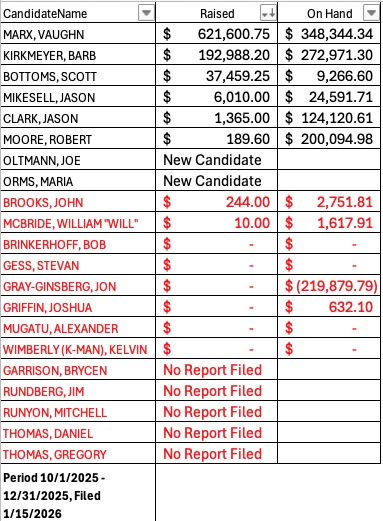
The undisputed headline is Victor Marx. The man absolutely torched the field financially. Raising over $621,000 in a single quarter and exiting the year with roughly $350,000 cash on hand, Marx now sits alone at the top of the money leaderboard. That kind of fundraising capacity matters, especially when everyone knows a serious general election run for governor in Colorado can chew through $30 million without breaking a sweat. This isn’t hype, it’s infrastructure. And infrastructure wins races.
Next comes Barb Kirkmeyer for Governor, who raised just shy of $200,000 in Q4 and reports $273,000 on hand. A healthy number, no question. But let’s be honest: a portion of that cash was carried over. That’s not momentum — that’s inertia. She remains financially viable, but money doesn’t change a voting record that mirrors a Democrat’s. Money certainly doesn’t fix a statewide electability problem Republicans have with a person who appears to be in the establishment donor class's pocket.
Scott T. Bottoms is the most interesting case study of the quarter. With his online presence, constant event schedule, and grassroots visibility, one would reasonably expect a stronger Q4 showing. Instead, he raised $37,459, closing the year with just $9,300 cash on hand. Bottoms remains a people’s-choice candidate, no doubt, but campaigns don’t run on applause. If he intends to survive beyond the state assembly and remain competitive as a primary candidate, the fundraising machine has to wake up and fast.
Then there’s Jason Mikesell, whose campaign appears to be suffering from acute political vertigo. He raised about $6,000 in Q4 and currently sits at $24,600 on hand. That’s not growth that’s stagnation. Given the trajectory, it’s difficult to see a path where this campaign survives state assembly, let alone advances beyond it.
Jason Clark raised a paltry $1,365 in the quarter but reports $124,000 on hand. I reviewed prior 2025 filings and didn’t see obvious personal loans, but regardless of how the money arrived, the reality is simple: cash on hand buys time. That alone keeps him alive for now. But without demonstrated fundraising capacity, this becomes a countdown clock, not a campaign.
Robert Moore raised $189 in Q4, yes, that’s not a typo, but loaned money into the campaign, leaving him with just over $200,000 on hand. That keeps the lights on, but it does not solve the central problem. Self-funding can bridge a gap; it cannot replace organic donor enthusiasm. If Moore were to emerge from the state assembly as a primary candidate, the math simply doesn’t work for a long-term statewide fight.
Two late entries deserve mention. Maria Orms is brand new to the race and already surrounded by controversy. Registered Republican, functionally unaffiliated, historically aligned with Democratic voting patterns, and spectacularly evasive on abortion she checks every box for a candidate who doesn’t align with Republican values while insisting she absolutely does. Early days, but the red flags are waving enthusiastically in most camps.
Then there’s Joe Oltmann, who entered the race just after Christmas and therefore has no filing yet. Joe is a known quantity in Colorado, polarizing, outspoken, and impossible to ignore. He says he’s running to represent people no one else is talking to, which is admirable. Whether that translates into assembly votes and then into a primary campaign is anyone’s guess. At this stage, it’s an interesting bid.
As for the rest of the field, the situation is blunt: many filed nothing at all. Others raised zero dollars. A few didn’t even bother pretending. These campaigns are effectively over, whether the candidates have accepted that fact yet or not.
Looking ahead, county caucuses and assemblies are just weeks away, followed by the state assembly on April 11, which promises to be every bit as chaotic as you’d expect. The call notice was thin, the logistics vague, and given Brita Horn’s track record (or lack thereof), I strongly recommend packing three meals and clearing your weekend. If you attend NASCAR to watch things go around in circles and possible crashes, bring popcorn; this assembly may deliver.
Money tells the truth long before ballots do.
This isn’t prophecy.
It’s math. And math doesn’t care about feelings.


Comments